
 Rose Chiffon
On this Page
If you have ever taken off a perfectly pretty bra at the end of the day and felt relieved to be out of it, you already know why construction matters. A bra can look lovely on a hanger and still feel completely wrong once you have lived in it for a few hours.
Most of us are not standing in front of a drawer thinking about engineering. We are thinking about the blouse we want to wear, whether the will annoy us by lunchtime, whether the cups will sit smoothly, and whether we will still feel comfortable when the day becomes longer than expected.
That is the useful way to think about underwired and wireless bras. They are not two sides we need to choose between. They are two ways of building a bra. The better question is: where is this bra getting its structure, and does that structure suit me?
What an underwire is really doing
Construction study
An is the curved piece that sits inside a fabric channel beneath and around the lower part of each . Its job is to help define the cup, support its shape, and work with the band, straps, seams, and fabric to hold the breast in the position the bra was designed for. [B01]
When the fit is right, the wire should breast tissue rather than sit on top of it. The width of the wire matters, the height at the centre matters, and the shape of the cup built around it matters. A low can feel very different from a full-cup bra even when both have a wire and both carry the same size on the label.
This is why I would never tell a woman who disliked one wired bra that she simply does not suit underwire. Sometimes she does not. Sometimes the real problem is that the wire was too narrow, too tall, too rigid, or attached to a cup shape that did not suit her body.
A wire can be excellent at creating a defined cup boundary, separation, and a more projected shape. For many fuller-busted women, that structure can feel reassuring. For others, a rigid frame is exactly the sensation they do not want. Both preferences are perfectly reasonable.
What changes when the wire is removed
A wireless bra does not stop needing support just because the metal disappears. The work simply has to be shared differently.
A thoughtful wireless design may use a wider , deeper cups, bonded support panels, firmer zones of stretch, side wings, internal slings, fabric, stronger , or broader straps. A very soft lounge bra may use almost none of those things because its purpose is ease rather than firm support.
That difference matters. The phrase wireless bra can describe something feather-light and barely structured, or something quite substantial and supportive. You cannot tell which one you are looking at from the word wireless alone.
Wacoal includes wireless among many different bra styles, which is a helpful reminder that wire is only one part of the design story. [B02] A wireless bra can still be full coverage, plunge, minimizer, T-shirt, sports-oriented, moulded, unlined, or decorative.
Where the support actually comes from
When a bra is uncomfortable, it is tempting to blame the most obvious part. The straps are digging, so we tighten or loosen them. The band feels wrong, so we change the band size. The cups look odd, so we change the cup letter.
Sometimes that works. Often the problem is the relationship between several parts.
| Part of the bra | What it contributes | What I would notice |
|---|---|---|
| Band | Anchors the bra around the torso | Does it stay level without feeling painfully tight? |
| Cups | Contain and shape breast tissue | Is there enough depth and room in the right places? |
| Underwire | Creates a firmer lower cup boundary | Does it frame the breast rather than sit on it? |
| Seams or moulding | Give the cup its intended shape | Does the cup shape agree with your own? |
| Side wings | Stabilise the sides and connect cup to band | Do you prefer a lighter side or broader coverage? |
| Straps | Help stabilise and refine position | Are they helping, or are they doing too much of the work? |
| Internal panels | Reinforce or redirect support | Can you see where the bra is adding structure without a wire? |
A wide can feel kinder on the shoulder, but it cannot rescue a badly fitting cup. A broad band can feel beautifully secure on one woman and far too much on another. A deep cup can be exactly what one breast shape needs and unnecessary on another.
The goal is not to collect features. It is to understand which features are solving your problem.
Bra names are useful, but they are not rules
One of the easiest ways to become frustrated with bra shopping is to assume every style name means exactly the same thing everywhere.
A T-shirt bra usually aims for a smooth appearance beneath fitted clothing. It may be wired or wireless. A full-coverage bra gives more coverage and containment, but greater coverage does not automatically mean greater support. A plunge bra lowers the centre so it can sit beneath a deeper neckline.
A usually has a broader, more horizontal neckline and straps placed farther apart. A generally gives less upper-cup coverage. Those descriptions overlap from brand to brand, so I use them as directions rather than promises. [B02]
A tends to be softer and less rigid, but it is not automatically a small-bust garment. Its usefulness depends on the band, cup construction, fabric , and size range.
A minimizer changes the way the bust is held and distributed beneath clothing. It does not make breast tissue disappear, and I would be cautious of any fixed promise about losing a certain number of inches. A minimizer can be wired, wireless, moulded, or unlined.
A strapless bra has to rely more heavily on its band and internal construction because there are no straps helping to stabilise it. A convertible bra changes strap positions for different clothes. A front-close bra changes where the fastening sits. A bra extends farther down the torso and spreads structure over a larger area.
A sports bra is its own conversation because movement matters. , , or a combination of both may be used, and the bra should be judged while you move, not only while you stand in front of a mirror. Nike's sports-bra fitting guidance makes that point clearly. [B05]
A sleep or lounge bra is about preference and softness. Some women enjoy a little support at home or while resting. Others would rather wear nothing at all. There is no prize for choosing either one.
Cup shape is often the part no one explained to us
Many women know their band and cup size but have never been told that cup shape can matter just as much.
A cup can technically have enough volume and still be too shallow, too tall, too narrow, or too wide. That is why a woman can try two bras in the same labelled size and feel as though one was made for her while the other belongs to somebody else.
If breast tissue is being pushed upward or sideways, if the cup feels tight in front but gaps elsewhere, or if you keep changing band sizes without solving the problem, cup depth deserves a closer look.
A deeper cup gives more forward room. A shallower cup distributes that volume differently. A seamed cup can create shape through several fabric panels. A moulded cup asks the breast to sit inside a pre-formed shape.
This is one reason we chose Comfelie's 3D Perforated Deep Cups bra as one of our wireless examples. It lets us point to something concrete. Sometimes the useful question is not “Is this more supportive?” It is “Does this cup make room where I actually need it?”
Comfort is information
A supportive bra should not require you to spend the day enduring it.
Bravissimo's fit guidance asks women to look at the band, cup, wire, and straps together, and that is exactly how I would approach it. [B03] If an underwire repeatedly sits on breast tissue, presses sharply at the centre, or digs under the arm, do not dismiss that as the price of support.
With a wireless bra, look at whether the band rolls or climbs, whether breast tissue slips beneath the cup, whether the centre feels stable enough for the design, and whether the supportive panels are helping or simply making the garment feel restrictive.
Then give the bra more than thirty seconds in front of a mirror. Sit down. Reach for something. Put your arms above your head. Walk around. Try the blouse or dress you actually intend to wear over it.
Straps that dig are not always asking for wider straps. They may be over-tightened because the band is not doing enough. A band that rides upward may be too loose, stretched out, or simply shaped poorly for your torso. Overflow can mean insufficient cup volume, but it can also mean the cup is too shallow. Gaping does not automatically mean the cup is too large. A tall or rigid cup can gap even when another cup of the same volume fits beautifully.
This is the part of bra fitting I wish more women were taught early: discomfort is not a personal failure. It is useful information about the garment and the match between that garment and your body.
A fuller bust does not have to mean underwire
A good underwired bra can be a wonderful choice for a fuller bust. It can give a clear cup frame, separation, and the projected shape many women prefer.
But fuller support can also be created without a wire. Wireless designs aimed at fuller busts often make their work more visible through deeper cups, broad underbands, stronger side panels, wider straps, internal bonded zones, and controlled stretch.
The important thing is to be honest about what you want the bra to feel and look like.
If you love the lifted, projected shape of a structured wired cup, a soft wireless bra may never feel like an equal substitute, and it does not need to. If you value flexibility and fewer rigid contact points, a wireless design may feel much more natural even if the is softer.
There is no more sophisticated choice here. There is only the choice that suits your body and the day you are dressing for.
Three Comfelie bras, three different reasons for choosing them
When we decided to show real examples in The Rose Books, I did not want three bras that were essentially the same thing in different colours. If Rose is going to place a product beside our guidance, it should help explain something.
Airlite is our lightweight example. The bonded construction, moisture-wicking fabric, and lower-bulk design make it the one I would look at when the priority is ease and a smoother, lighter everyday feel.
The 3D Perforated Deep Cups style is our depth example. It belongs here because it makes a common fitting issue easier to see. If you regularly feel as though your breast is being asked to sit in a cup that is too flat, this is the kind of construction worth comparing.
The Invisible Powerband is our fuller-support example. Its wider underband, deeper cups, side structure, and broader straps show how a wireless bra can distribute support across the garment rather than relying on one rigid frame.
We selected these three because each one has a clear reason to exist. Their dedicated Rose Selection pages explain what stood out to us, what the construction is designed to do, and when I would suggest looking at a different bra instead.
That last part matters. A recommendation feels more trustworthy when it also tells you who may be happier with something else.
So, wired or wireless?
Start with the life the bra has to fit into.
If you enjoy a defined cup boundary, clear separation, and the shape a structured wired cup can create, start with underwire. Pay attention to wire width, centre height, cup depth, and how the bra feels after you have moved in it.
If you dislike rigid contact points, prefer flexibility, or simply feel better in softer modern constructions, start with wireless. Then look beyond the word wireless and ask where the support is coming from.
If the neckline of your dress is low, compare plunge bras. If you want a smoother look beneath a fine knit, compare T-shirt and seamless constructions. If you dislike cup bulk, look at unlined options. If you need support while moving, look at sports-specific designs. If the bra is mainly for home, there is nothing wrong with choosing softness over structure.
And if one bra cannot do all of those jobs, that is not a failure of your wardrobe. Most of us do not expect one pair of shoes to work for the office, a wedding, a long walk, and an evening at home. A bra deserves the same common sense.
The question I would take into the fitting room
Before buying your next bra, finish this sentence:
“I want this bra to be better at…”
Maybe you want it to disappear beneath a fitted top. Maybe you need more cup depth. Maybe you want less pressure from rigid components, more side coverage, a lower centre for a favourite dress, or a band that feels steady without feeling heavy.
Once you can name the need, the labels become far more useful. You can compare the details that matter and ignore the ones that do not.
That is what I want The Rose Books to do for you. Not turn getting dressed into an examination, and not tell you that you need another thing to buy. I want you to understand the garment well enough that the next choice feels calmer, more personal, and much more your own.
Rose Selections · Comfelie
Three wireless bras, three different jobs.
Rose compared Comfelie’s current wireless range and chose a deliberately small group that teaches the differences rather than repeating the same idea. Each dedicated page explains what makes the construction useful, how it is designed to feel, and when another bra may be the better choice.
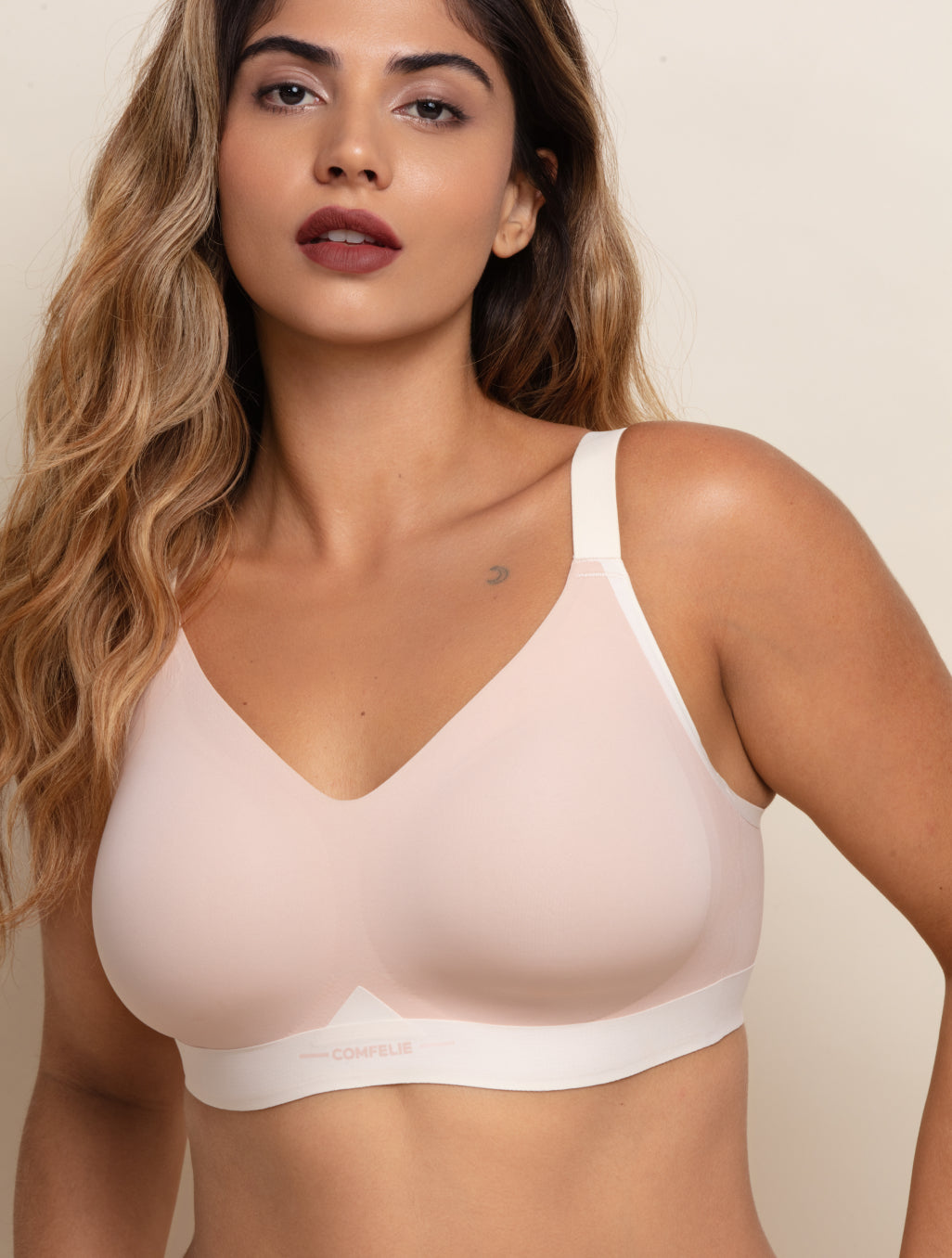
Rose Selection · Lightweight wireless
Airlite Only 89g Wireless Comfortable Bra
The one I would look at first for a lighter everyday feel
For the woman who wants her everyday bra to feel present as little as possible, Airlite is the Comfelie style that stood out to us for its lighter construction, smooth finish, and clear comfort-first purpose.
Why Rose chose this piece →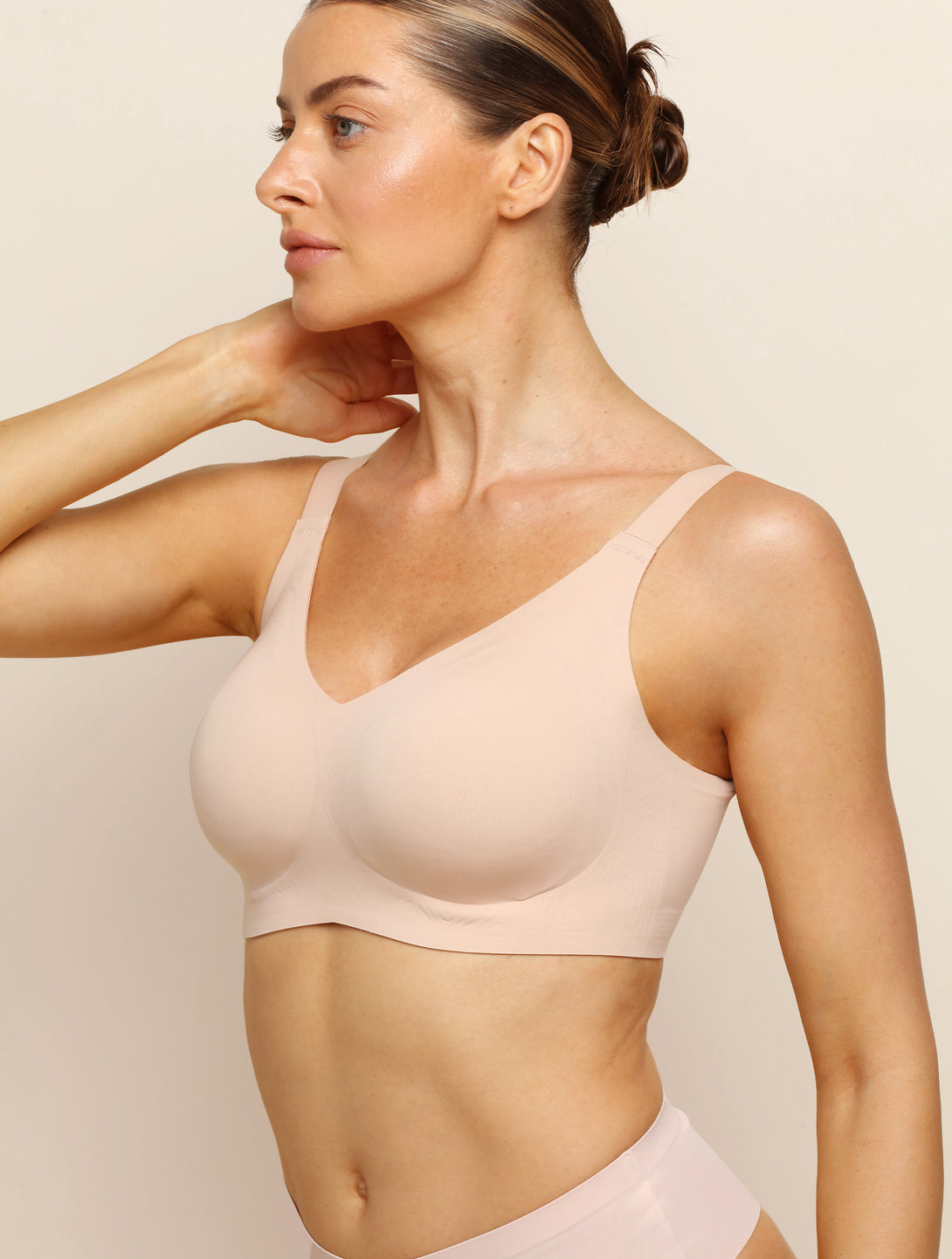
Rose Selection · Deeper-cup wireless
3D Perforated Deep Cups Comfortable Bra
The one I would compare when cups often feel too shallow
If you often find that the band seems reasonable but the cup still feels flat or restrictive, this is the Comfelie bra I would use to show why cup depth can matter as much as the size printed on the label.
Why Rose chose this piece →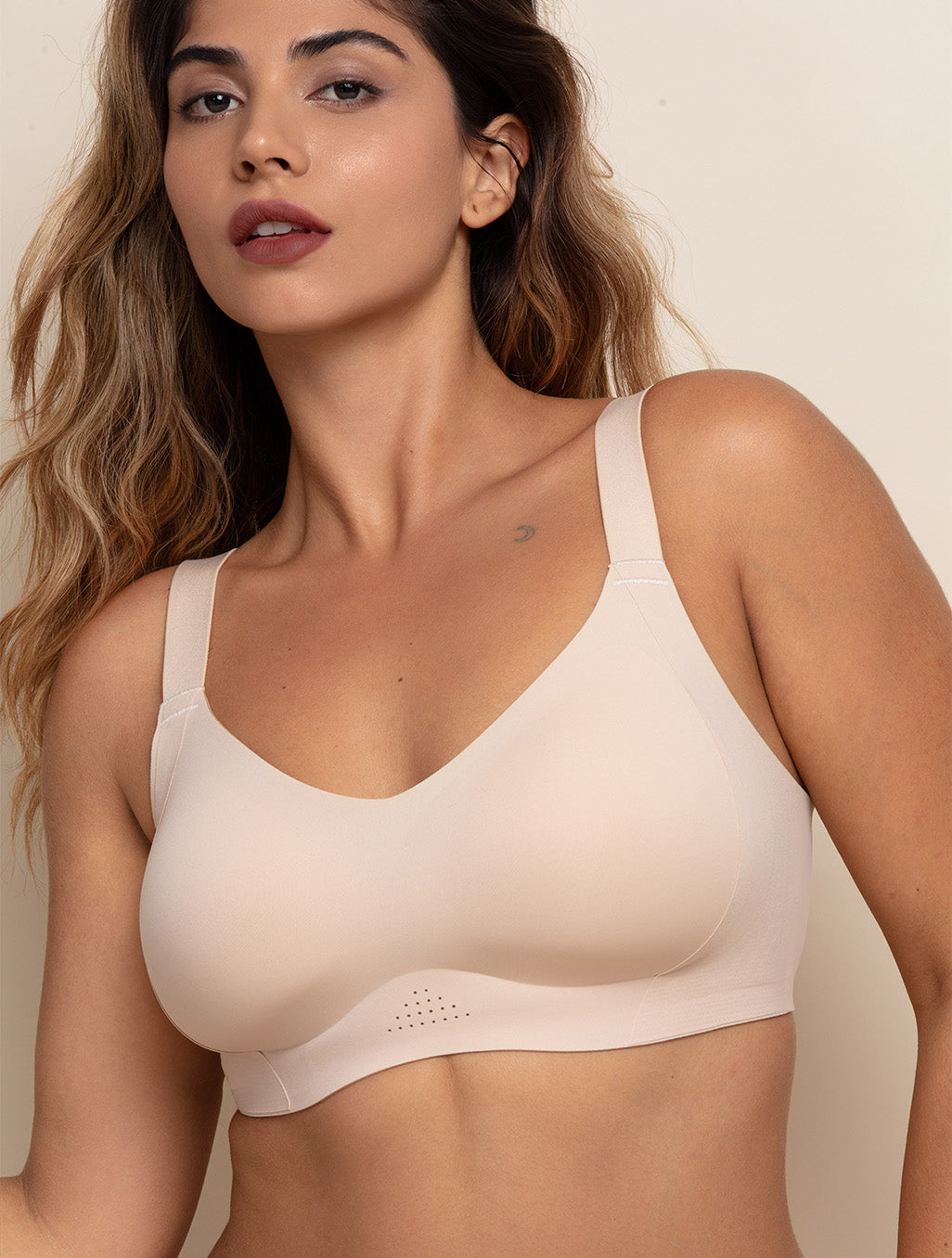
Rose Selection · Fuller wireless support
Invisible Powerband Wireless Supportive Bra
The one I would compare for a more anchored wireless feel
For the woman who wants wireless comfort but still likes to feel securely held, Powerband is the strongest example in this group of how support can be spread through the band, straps, cups, and side structure.
Why Rose chose this piece →These are editorial selections, not claims that one bra will fit every body. Some Rose Selections may also appear in the catalogue; future selections do not have to.
Sources & editorial notes
Reference material, not affiliate recommendations. Manufacturer examples describe particular constructions rather than universal fit promises.
- [B01] Wacoal · Bra Anatomy↗ new tabNames and functions of conventional bra components; no universal support percentage or mandatory body position adopted.
- [B02] Wacoal · Bra Styles↗ new tabManufacturer terminology for bra families. Retail names are treated as overlapping descriptions.
- [B03] Bravissimo · Bra Fitting Guide↗ new tabBand, cup, wire and strap observations. This is garment guidance, not diagnosis.
- [B05] Nike · Women’s Sports Bras: Fit Guide↗ new tabManufacturer support categories and movement checks, not independent laboratory certification.
Continue through the Book